
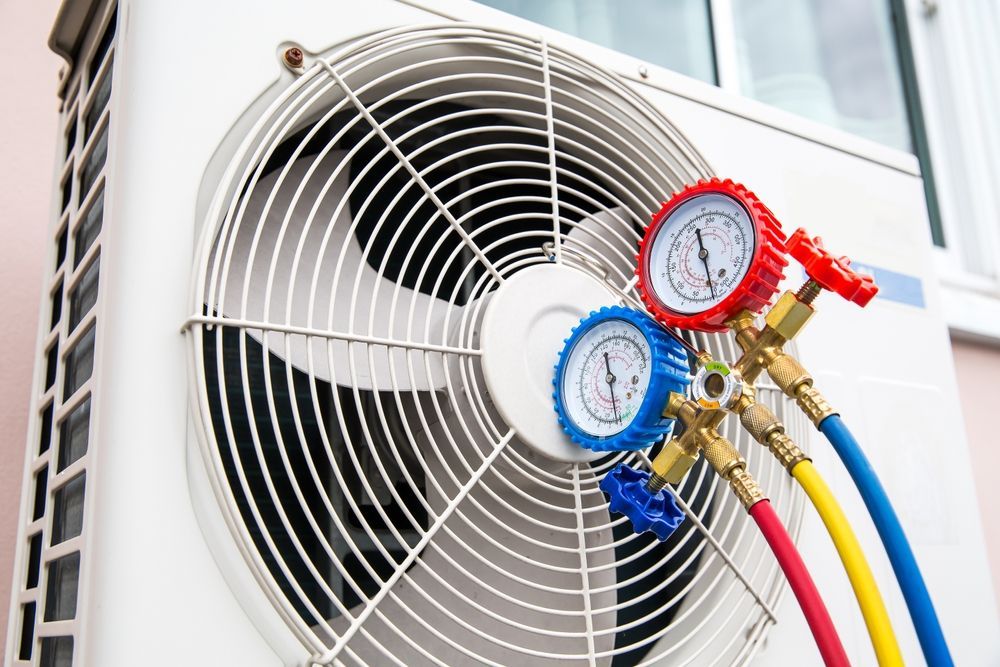
One System Handling Both Heating and Cooling Loads
Heat pump installation and repair in Lawrence for homes replacing separate heating and cooling equipment or addressing system failures
Properties in the Clinton area and across the rural stretches of Lawrence County increasingly include heat pumps as the primary conditioning system—a choice that made less economic sense when equipment costs were higher but now represents a straightforward option for homes that would otherwise maintain a furnace and central air conditioner as separate systems. RME Heating & AC installs and repairs heat pumps in Lawrence, working from a complete load calculation before any installation begins to confirm the unit is sized for the actual heating and cooling demand of the space rather than an estimated square footage figure.
Installation involves evaluating the home's heating and cooling load, positioning and mounting both the indoor air handler and outdoor condenser unit, establishing correct refrigerant charge, and verifying thermostat integration before the system is tested under operating conditions. For repair, the technician diagnoses the specific failure—refrigerant leaks, compressor issues, blower motor failures, and reversing valve problems each produce distinct symptoms and require different interventions. RME Heating & AC services all major HVAC brands and uses quality parts and proven repair methods, so the diagnostic approach is matched to the specific equipment rather than applied generically.
To discuss installation sizing or arrange a diagnostic for an existing heat pump, call RME Heating & AC at (785) 764-8931.
What Proper Heat Pump Installation and Repair Requires
Sizing a heat pump incorrectly is one of the most common installation errors, and it produces problems that no amount of subsequent maintenance can fully correct. An undersized unit runs continuously without reaching set temperature during peak demand; an oversized unit short-cycles, which means it satisfies the thermostat call before completing a full conditioning cycle, leaving humidity control incomplete and compressor wear accelerated by frequent start sequences. The load calculation performed before installation accounts for the home's insulation values, window area, ceiling height, and occupancy pattern—not just the floor plan dimensions.
After installation, the system should reach set temperature within a normal operating cycle and maintain it without running continuously. Refrigerant charge verified at startup is a key indicator of correct installation: a system with an improper charge will not reach rated efficiency regardless of how clean the coils are or how well the ductwork is sealed. For repaired systems, the observable change depends on the component that failed—a reversing valve replacement restores the ability to switch between heating and cooling mode, while a compressor repair restores the pressure differential the refrigerant cycle depends on to transfer heat.
Heat pumps that are maintained on a consistent schedule hold their efficiency ratings across more of their service life than those that run without periodic inspection. Coil cleaning, refrigerant level verification, and blower assembly inspection are the three highest-impact maintenance tasks for heat pump systems, and they carry over directly from the standard HVAC tune up process.
Questions Before Starting Your Heat Pump Project
These questions address how heat pump installation and repair work is approached, what the process involves, and what factors affect the decisions made during the job.
What does a heat pump load calculation involve?
The technician measures or gathers data on the home's conditioned square footage, insulation levels, window area and orientation, ceiling height, and internal heat sources to calculate the actual heating and cooling demand. That figure determines the correct equipment capacity rather than relying on rules of thumb based on square footage alone.
How is a refrigerant leak diagnosed in a heat pump system?
The technician uses an electronic leak detector to identify the location of the leak, verifies the finding with a dye trace or pressure test as appropriate, and repairs the leak at the source before recharging the system to manufacturer specification. Recharging without locating and repairing the leak results in the same failure within a short operating period.
What does a reversing valve do and how does failure show up?
The reversing valve controls the direction of refrigerant flow, which determines whether the system is operating in heating or cooling mode. A failed reversing valve typically presents as a system that can condition in one mode but not the other, or one that produces neither heating nor cooling despite the compressor running.
Why does correct outdoor unit placement matter for heat pump performance?
The outdoor condenser needs adequate clearance for airflow on all sides and should not be positioned where it will draw in recirculated air from its own exhaust. In Lawrence properties with tight side yards or enclosed equipment pads, placement decisions made during installation directly affect how efficiently the unit operates across its service life.
How do you know if a heat pump repair has been completed correctly?
The system should complete a full heating or cooling cycle, reach the thermostat set point within a normal operating window, and hold that temperature without short-cycling. A technician should verify refrigerant charge and system pressures before the visit is closed out.
RME Heating & AC also installs and repairs heat pumps in Baldwin City, Eudora, Lecompton, and Ottawa. Call (785) 764-8931 to arrange a site evaluation or system diagnostic and get a clear assessment of what your property requires.